
Reed sensors – reliable switching technology
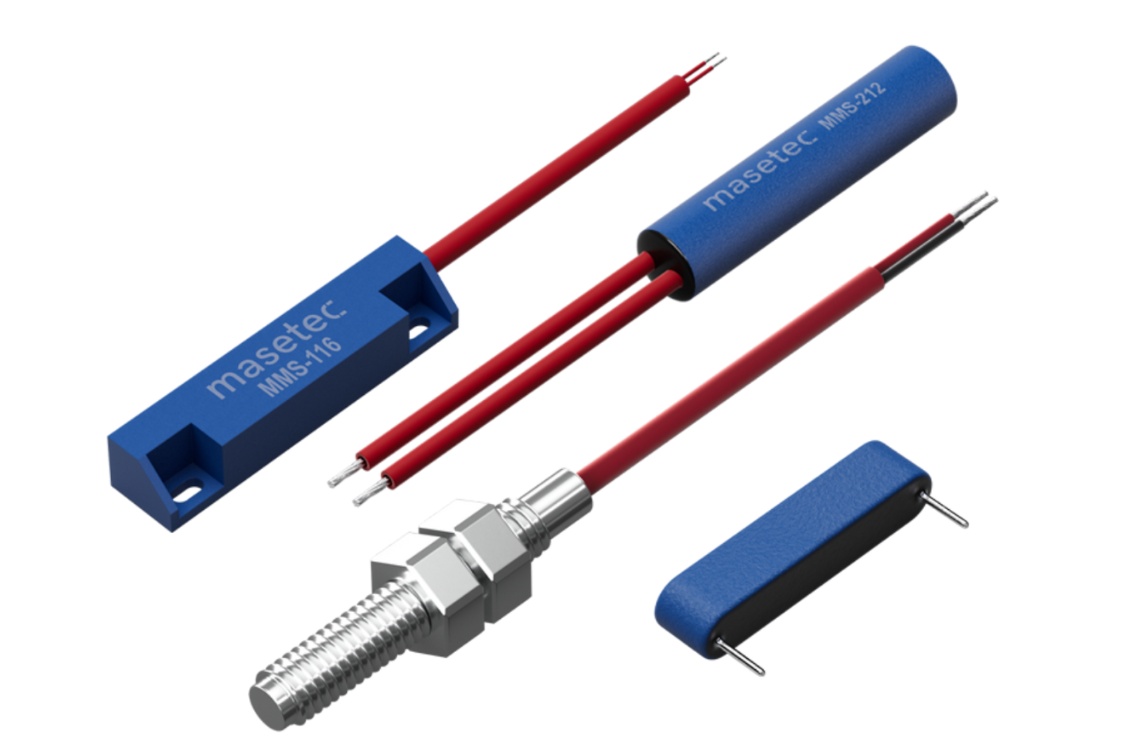
Our reed sensors ensure precise and reliable switching operations—whether as a standard solution or customized. Available in various housing types such as tubular, flange, THT and tubular-threaded, they offer fast availability and excellent value for money. Rely on proven technology for your applications.
Application Areas

Position control, contactless switching
All benefits at a glance
Contactless switching technology:
No mechanical wear, as no direct contact is required.
High reliability:
Long service life thanks to minimal wear and a robust design.
Low power consumption:
Does not require a continuous power supply—ideal for energy-efficient applications.
Versatile applications:
Suitable for industrial, medical, automotive and safety-critical applications.
Resistant to environmental influences
Operates reliably in humid, dusty or dirty environments.
Compact design:
Enables easy integration, even in space-constrained applications.
High switching accuracy:
Precise response to magnetic fields for accurate switching operations.
Cost efficiency:
Cost-effective alternative to other sensor technologies with low maintenance requirements.
Applications of reed sensors
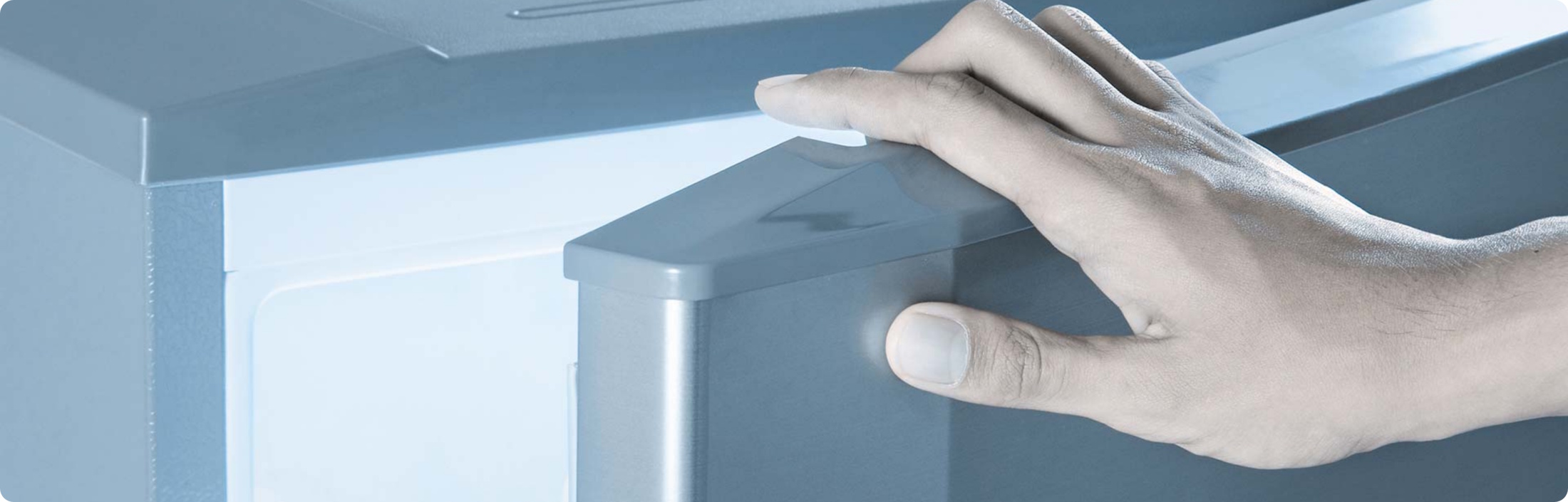
Reed sensors are used in a wide range of applications. From position detection on a refrigerator door to the external adjustment of a pacemaker, they perform their tasks reliably. As level sensors with floats, they are used to monitor and display tank fill levels; flow sensors are used to monitor flow in lines carrying liquids and gases.
Design of reed sensors
The core component of reed sensors is, of course, the reed switch. It is potted in a housing using, for example, two-component epoxy adhesive. Before the reed switch is installed in the housing, cables are soldered on in most cases so that the reed switch can be contacted after potting. The cables can be connected using hundreds of different connectors, which masetec is also happy to pre-assemble for you.

How reed sensors work
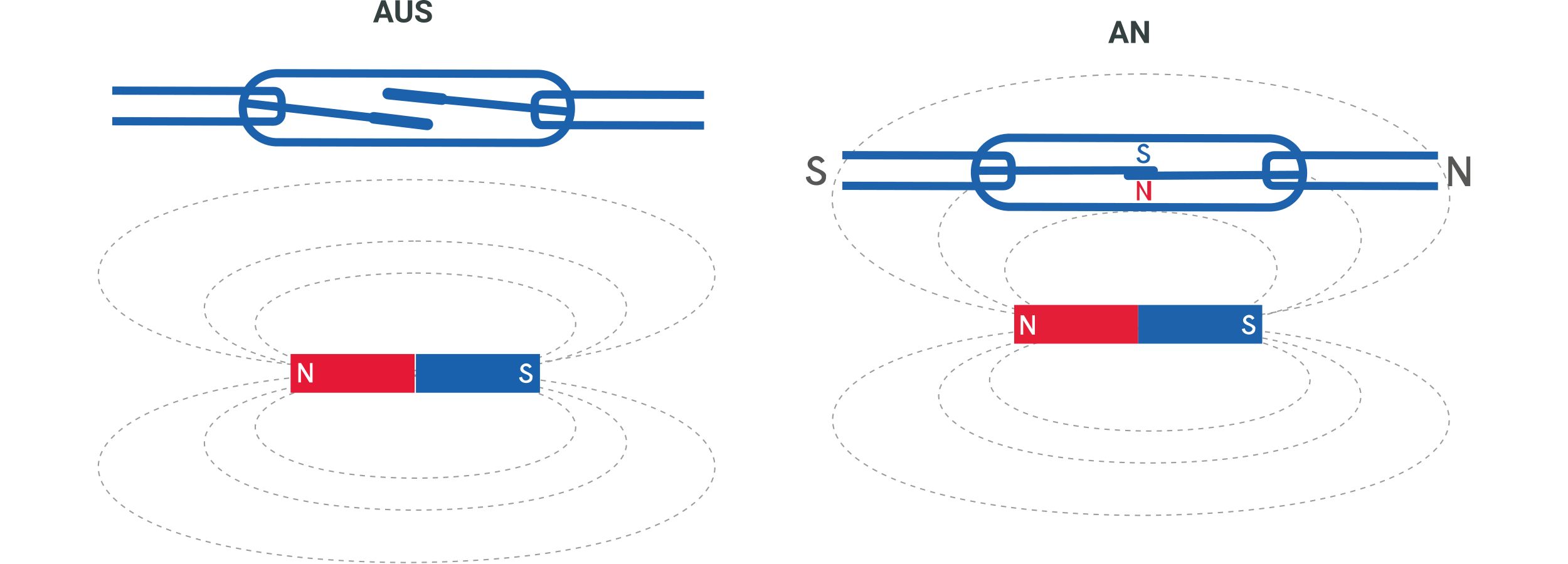
Reed sensors have four operating modes. The most common reed sensors are normally open contacts. They consist of two flexible, magnetizable reeds. Under the influence of a magnetic field, the contact surfaces touch. This allows current to flow through the switch.
Normally closed contacts can generally be implemented in two ways: either a changeover contact is used but only the normally closed contact is soldered, or an external magnet is attached to a normally open contact to keep the reed contact closed. It then opens when an external magnet with opposite polarity approaches the reed contact.
Without a magnetic field, the changeover reed touches a normally closed contact, and in the active position it touches a normally open contact.
Which product are you looking for?
Our reed sensors at a glance
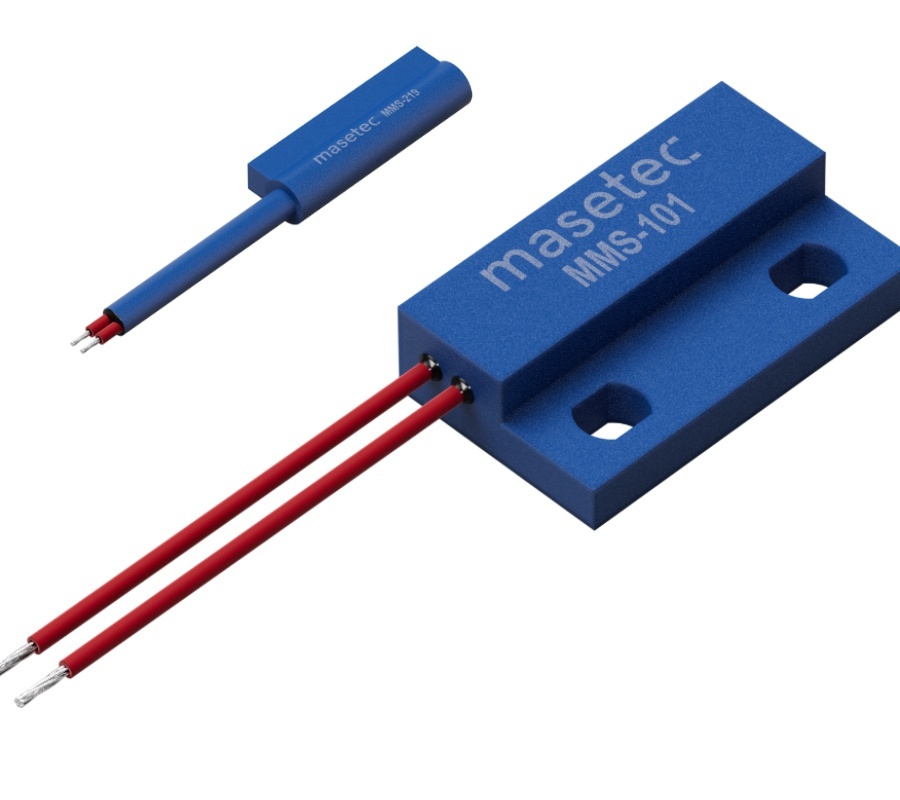
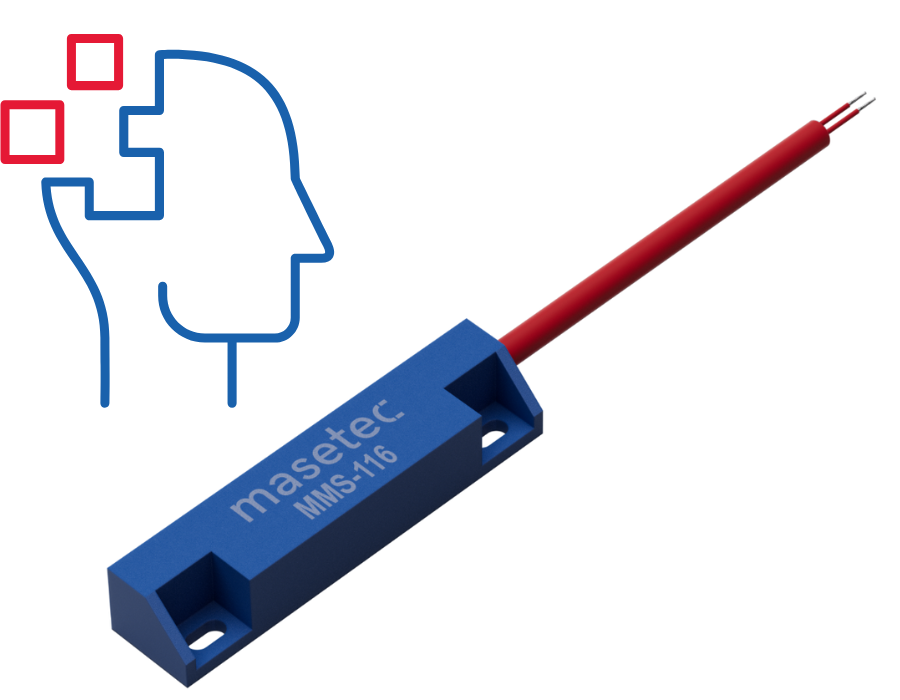
Flat housing
Reliable solution for space-saving applications
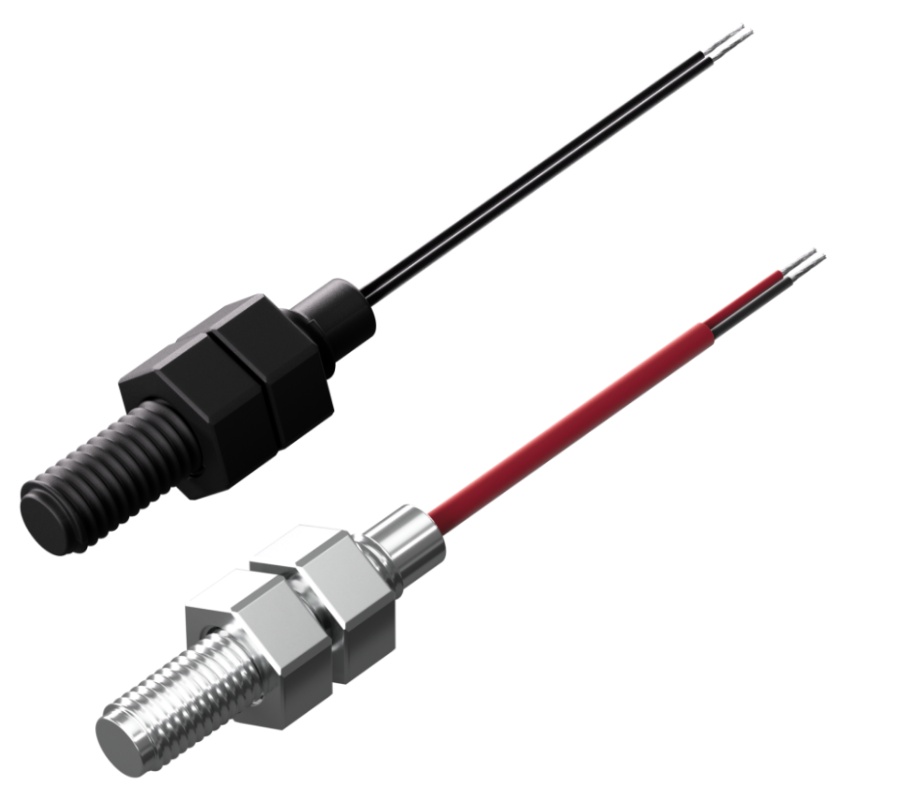
Threaded housing
Easy installation and high precision
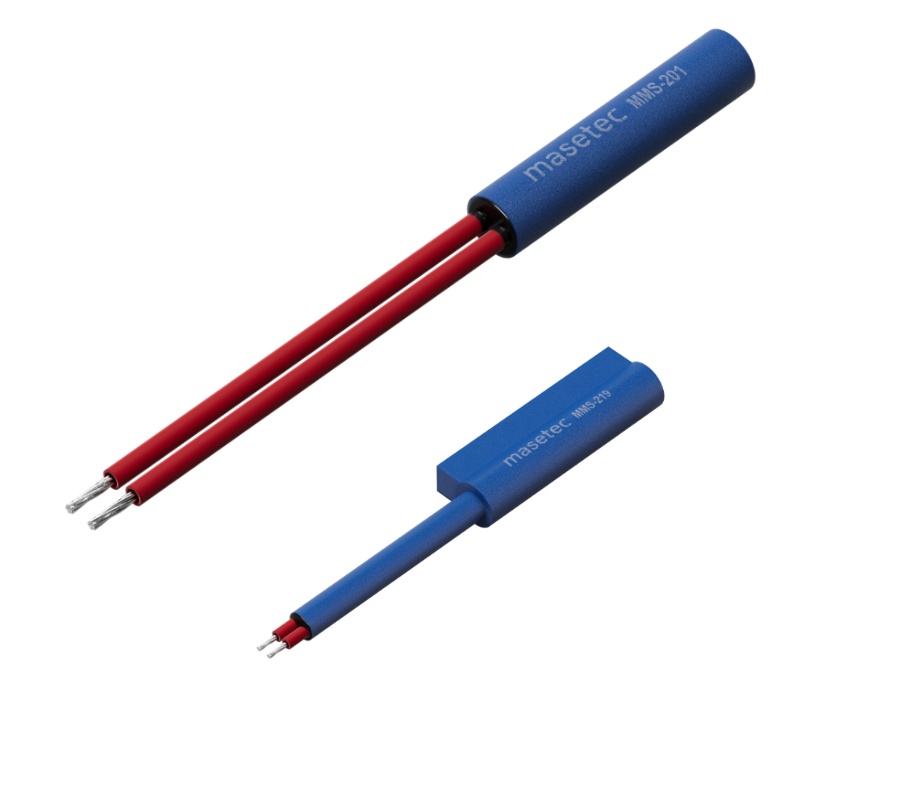
Cylindrical housing
Precise functionality and easy integration
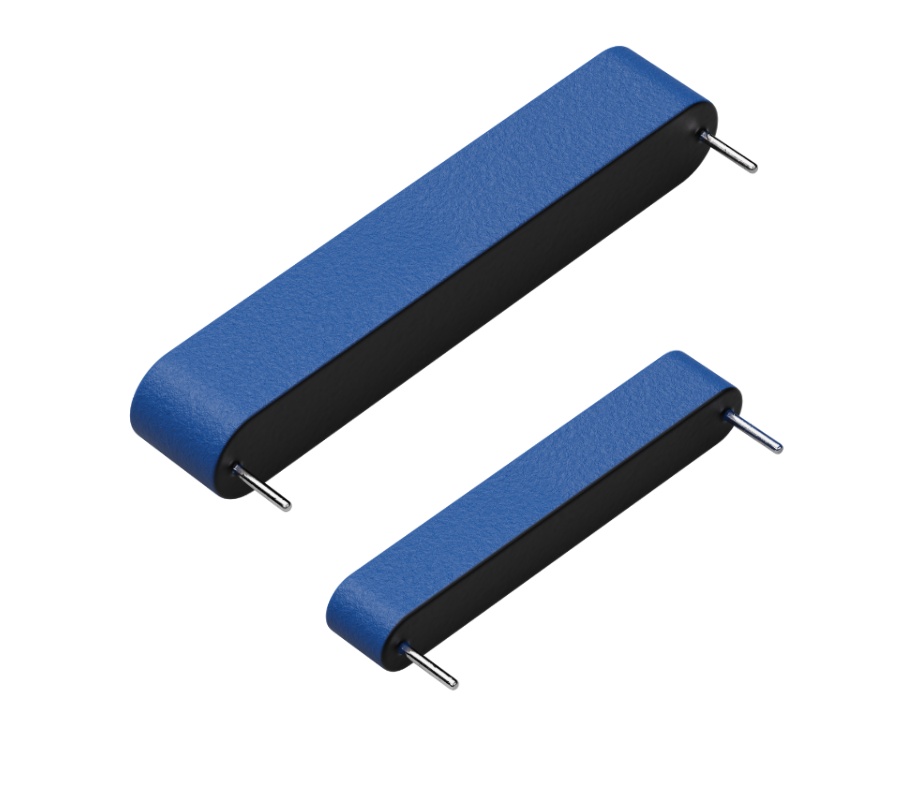
Leaded
Easy handling and reliable performance

Do you require a customized solution?

Customizing reed sensors
When manufacturing customized reed sensors, various specific adaptations can be made to optimally meet the requirements of your application. Some of the most important adaptations are:
1. Dimensions and shape
The size and shape of the reed sensor can be adapted to the available installation space and the specific mounting method. Using various technologies, we can offer cost-effective tooling solutions starting from €1,000.
This enables us to offer you customized solutions with low investment costs.
2. Magnetic sensitivity
The sensitivity of the reed switch can be adjusted for different actuation distances and magnetic field strengths.
3. Operating temperature range
4. Connection types
The type of electrical connections, such as cables, connectors or PCB terminals, can be adapted to the specific requirements of the application.
5. Housing material
Depending on the application, the reed sensor housing material can be optimized for different environmental conditions, such as PA66, brass, PBT, PP or ABS.
6. Mounting modifications
These adaptations make it possible to use reed sensors in a wide range of applications, from simple position sensors to complex safety and control systems.
Reed sensor FAQ
Do all manufacturers have the same AW values? In other words, are 10–15 AW from my current supplier interchangeable with 10–15 AW from masetec?
Unfortunately not—or at least it is risky. In reed technology, as in other fields, efforts are made to avoid easy switching from one manufacturer to another. Many factors matter here, such as the number of turns in the respective test coil. A coil with 5,000 turns naturally has a different value than one with 10,000 turns.
I often see the abbreviation “AW”—what is it?
Exactly—pay close attention. AW stands for ampere-turns and is probably the most important value in the reed world, as it defines sensitivity, i.e., the switching distance. Caution: an AW value of, for example, 10–15 AW is often equated with a switching distance of 10 to 15 mm, which is completely incorrect. The sensitivity of reed switches is determined in predefined coils. By applying a voltage to the coil (current flow) with a defined number of coil turns, a magnetic field is generated. If I then increase this current until the contact closes, I have determined the pull-in value (A × W). If the current is then reduced until the contact opens again, this results in the drop-out value.
What is the difference between a reed sensor and a reed switch?
Good question. A reed switch installed in a housing is generally referred to as a reed sensor; the uninstalled reed is the switch.
How does a reed sensor or reed switch work?
This is, of course, the most important question, because this knowledge opens up countless applications.
Two contact reeds made of ferromagnetic material are hermetically sealed into a glass tube under an inert atmosphere (e.g., nitrogen). After sealing, the overlapping contact reeds inside the glass body form an air gap in the contact area. For improved switching performance, the two reeds are coated in the so-called contact zone with ruthenium, rhodium or iridium. The key point is that, with a sufficiently strong magnetic field, the two contact reeds assume opposite polarity and thus close the contact.
What different types of reed switches are there?
Most reed switches/sensors are so-called SPST-NO (Single-Pole-Single-Throw–Normally-Open) types and are also referred to as Form A switches (normally open contact). However, many reed-based applications require an SPST-NC (Single-Pole-Single-Throw–Normally-Closed) or Form B (normally closed contact). In addition, SPDT (Single-Pole-Double-Throw) or Form C (changeover contacts) are indispensable in numerous applications. In a few products, bistable switches—also known as Form E or latching—are used.
How do I achieve the largest or smallest possible switching distance?
We know that every application requires different distances. To achieve these, we can either adjust the AW value, use a stronger or weaker magnet, or even adapt the magnet material. Revising the position of the magnet relative to the reed could also lead to the desired result. In the download area, you can find information on the different approaches and the resulting changes in switching behavior.
Can you modify reed switches for us?
We know how difficult it can be to modify reed switches—therefore we offer this service. Whether cutting, bending or other adaptations: there are numerous ways to precisely tailor reed switches to your requirements.
Is there only one standard?
No—of course not. We can adapt our reed switches to your application.