



Neodymium Magnets (NdFeB)
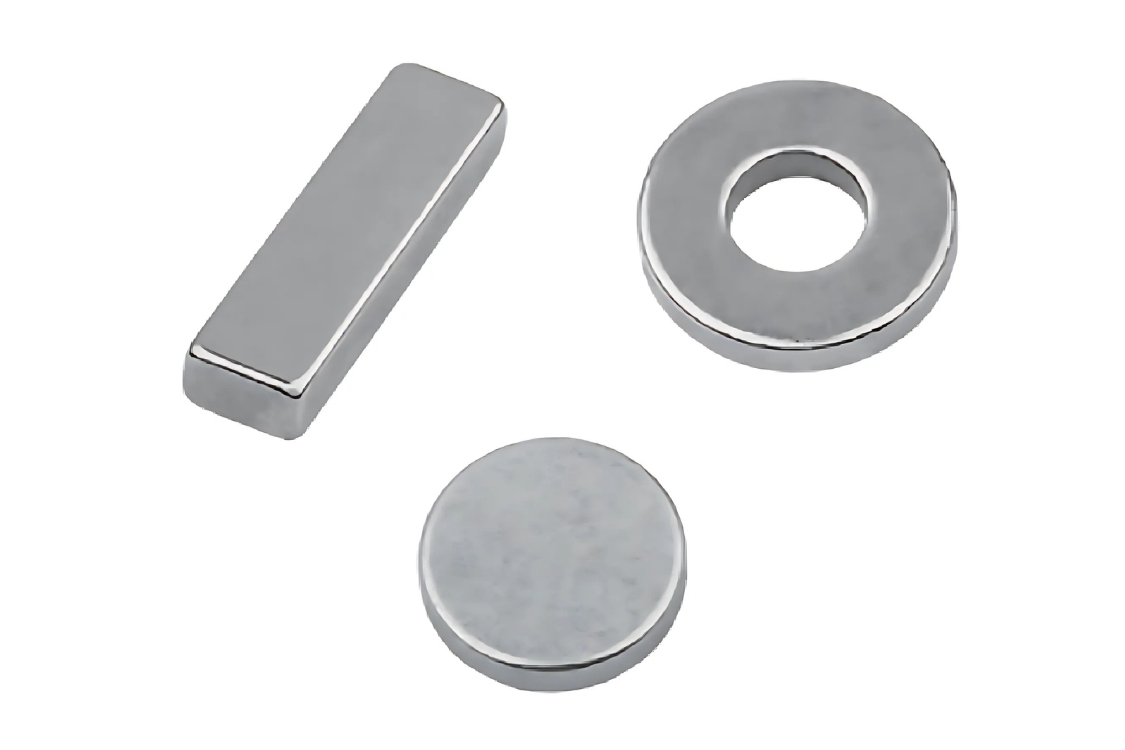
Neodymium iron boron magnets (NdFeB) are among the strongest permanent magnets and provide maximum magnetic force in the smallest of spaces. Thanks to their high energy density, they are ideal for demanding applications in industry, technology, and electronics. masetec offers a wide selection of NdFeB magnets – perfectly tailored to your requirements.
Application Areas

Position control, contactless switching, speed measurement
All advantages at a glance
Extremely high magnetic force:
Strongest permanent magnets for maximum performance.
Space-saving:
High energy density enables compact design.
Versatile applications:
Ideal for industry, technology, and electronics.
Durable:
High resistance with the correct coating.
Individually customizable:
Available in various shapes, sizes, and alloys
Caution with NdFeB magnets
Coating required:
For use in humid or aggressive atmospheres, a coating for corrosion protection is essential.
Not infinitely temperature-resistant:
Maximum recommended temperature is +230°C.
Observe temperature coefficient:
Always depending on the grade
Use of NdFeB magnets
Due to their stable and high magnetic effect with low heat generation, NdFeB magnets are particularly suitable for sensor technology or in electric motors and generators. They are even frequently used in wind turbines. Advantages of NdFeB magnets include their high adhesive strength even at small sizes and their low cost. This saves both space and money.

Structure of Neodymium Magnets
Neodymium magnets (NdFeB) consist of an alloy of neodymium, iron, and boron. This composition gives them an exceptionally high magnetic force. To prevent corrosion, they are often provided with a protective coating of nickel, zinc, or epoxy resin. Depending on the application, they can be manufactured in various shapes and magnetization directions.
Production of Neodymium Magnets
Coatings on NdFeB Magnets
NdFeB magnets are susceptible to corrosion and are therefore coated with protective layers such as nickel, zinc, or epoxy resin. These coatings increase resistance to moisture, chemical influences, and mechanical wear, making the magnets more durable and robust.
Magnet Selection Guide
| ENERGY PRODUCT | Ferrite | AlNiCo | NdFeB |
| COSTS | Ferrite | AlNiCo | SmCo |
| MAX. OPERATING TEMPERATURE | NdFeB | SmCo | AlNiCo |
| CORROSION RESISTANCE | NdFeB | AlNiCo | Ferrite |
| RESISTANCE TO DEMAGNETIZATION | AlNiCo | Ferrite | SmCo |
| MECHANICAL STRENGTH | Ferrite | NdFeB | AlNiCo |
| TEMPERATURE COEFFICIENT | AlNiCo | SmCo | Ferrite |
| MAGNETIC STABILITY AT HIGH TEMPERATURES | NdFeB | Ferrite | SmCo |
| Energy product | Ferrite | AlNiCo | NdFeB |
| Costs | Ferrite | AlNiCo | SmCo |
| Maximum operating temperature | NdFeB | SmCo | AlNiCo |
| Corrosion resistance | NdFeB | AlNiCo | Ferrite |
| Resistance to demagnetization | AlNiCo | Ferrite | SmCo |
| Mechanical strength | Ferrite | NdFeB | AlNiCo |
| Temperature coefficient | AlNiCo | SmCo | Ferrite |
| Magnetic stability at high temperatures | NdFeB | Ferrite | SmCo |
◀ Please scroll table horizontally ▶
Which product are you looking for?
How can I help you?
I look forward to meeting you and working together to find the ideal solution for your challenge.


Call me:

Send us an email
jb@masetec.de